Ok, so I decided it was time to write this post.
I have a son (DS 8) and daughter (DD 9) - both of whom are formally diagnosed as having Autistic Spectrum Disorder. It was a long and difficult journey to get both of them diagnosed, and I sometimes forget, having been fighting so long, what it was like at the beginning and that there are many of you out there still at the start of this journey, or wondering if, maybe, this might apply to your child.
So, I will do my best to help by giving as accurate information as I can recall from our own experience. There's so much more than I could ever hope to cover in one Blog post, but hopefully this is a helpful start for some of you.
My son was the first to receive diagnosis - but it took 3 years from the start of the referral/ investigation to actual diagnosis.
With my son, there were signs from the beginning. Signs I, at the time, didn't recognize. He was a bright, bubbly, engaging, bundle of fun. He wasn't unresponsive. He wasn't unaffectionate. But he was under-responsive to touch - he did not enjoy light touch, stroking, tenderness. He liked to be held, firmly. He liked to be swaddled. He like to be picked up and carried, everywhere, always.
His fine motor skills were ahead of his age. Infact he ate ably with a knife and fork well before his contemporaries. It was the same with crawling, standing, walking. All milestones we proudly hit ahead of time. But he never stopped moving. He never stopped sensory seeking. He was always pulling himself up something, putting something in his mouth and he did rock, and he would pull himself to the doorways and sit and bang his head into the door frame repeatedly if you did not intervene. He was never distressed, he seemed to crave the sensory feedback.
He was loud, he was a loud baby. He had a loud cry, he called out a lot, it was like he desperately had things to say. But speech and language was a problem. We started Baby Sign at a young age. I say we started Baby Sign, actually we watched Mr Tumble and he saved our lives!! Through Justin Fletcher, we learned to communicate with our struggling toddler. We had stock phrases we learned - "The squirrel is up the tree" and "the tractor is red". When a meltdown occurred, we would say and sign these phrases together, and just the fact he was able to communicate SOMETHING and be understood, had a remarkably calming effect.
Justin Flectcher's Something Special also helped us with outings and holidays. We basically watched and re-watched the episodes, as both the children loved and responded to the programme so well, and did what he did. We hadn't realized, at the time, why going to new places - or indeed anywhere, ever - was such an issue. But it was, it really was. But thanks to Mr Tumble and his going out & about, we recorded and watched and re-watched those episodes and went to the places he went so that there was familiarity for the kids and we could use the sign language he used to aid communication at those places.
So yes, there were signs, that we didn't recognize.
Another sign was that both our children only ever liked 'real life' TV programmes. They were totally disinterested in animation of any kind until they were much, much older - I would say age 5 plus. Prior to this, it was Something Special, I Can Cook and Chris & Pui. Anything without real life situations would not spark their interest.
My son did not sleep. And I mean, at all, ever. The only time he napped is if he feel asleep on a feed. If he didn't, you could forget it! As he got a little older, he would only motion sleep - in the pushchair, in the car, physically being rocked. Once he was asleep you could not transfer him. I used to watch friends, enviably, move their sleeping infants and tots and put them down in their cots for an hour. How did they do this??? I remember my mother, and the health visitor, telling me I was doing it all wrong. I remember being told to try controlled crying. It didn't work. I remember my mother coming and taking the baby, my son, from me one morning and trying to show me how to 'do it properly and not get myself in such a state'. Four hours later, a broken woman, she came back down the stairs and asked me where my 'f***ing pushchair' was! At least I knew then it wasn't me!
As he got a little older, toddler age, he was a joy. Totally happy to play for hours at your feet - any kind of sensory play - water, sand, mud, toy kitchen etc. But he did not, could not, play with other children. He didn't go through the terrible twos. He didn't push, snatch, bite like the others. He couldn't understand why they did. It never occurred to him to take a toy off another child, or push ahead on the slide. Why would you? And I watched, heartbreaking, his perplexed little face when others did it to him.
He had a whole and varied vocabulary but he needed me to translate everything for him, as I was the only one who understood it. In time, when he joined pre-school, he was referred to Speech & Language. They worked with him on his sounds. They immediately saw that he could not make eye contact, that he was distracted, that he did not recognize facial expressions and that he could not correctly sequence orders of events. This SHOULD have been their cue to refer him for paediatric investigation (I didn't know that then). They failed. They gave me the details of a SEN website to look at and sent us away after 6 weeks when he could pronounce his g's 😖😖
At pre-school his key worker saw all I saw, but simply could not get her superiors to agree to refer him. So I brought him in, kicking and screaming, day after day. She would settle him, he would come home and it would all come tumbling out. He would bang his head until his nose bled, he couldn't sleep, he would bed wet and cling and cry.
There were other signs. Sensory issues with clothes. He would only wear stuff he could pull on or off. No buttons, zips or labels. For over a year he wore the same Spiderman costume every day - like a giant security blanket protecting him from a world so loud and confusing.
He would choke when he ate - he would overfill his mouth to the point of choking. He lost the ability to use a knife and fork and began to eat with his hands. He could not recognize hot temperatures so would burn himself on food.
He had an utter disregard for safety - particularly around water.
He would wander.
He would constantly have his back to you. He would never respond to you calling his name.
He was tested for glue ear. Given gromets.
His eyes were tested. He was given glasses.
His kidneys were investigated. It was found he has a mild kidney condition so the bed wetting was to be expected.
He cried, a lot. He complained of headaches and stomach aches, constantly.
He misjudged distances and frequently walked in to doors etc. Similarly he would hold on to things all the time he walked around the house and complained of feeling like he was falling.
He cried, a lot.
He had physiotherapy intervention for 4 years for his hypermobility. Eventually his, very excellent, physiotherapist signed him off - with a referral saying in her opinion there was more to investigate and that his issues were likely more due to ASD, ADHD or dyspraxia - or a combination of the three. Her advice and request for referral was ignored.
He cried, a lot.
We started mainstream school. All of the above issues, and more, continued. As soon as he started school he was placed on School Action plus - I wasn't told. He had daily 1-2-1 intervention to help with his speech and language and social understanding. I wasn't told. I was told he was a good boy, a nice boy, a caring boy, obedient, sweet, kind. He was, he is.
He cried, a lot.
The bullying started. Other kids quickly realized he didn't understand the social order of things. He had trouble distinguishing between friend and foe, and what was social play and banter and when he was actually at risk. I did start to get telephone calls - he had been hit in the privates, every lunch time 3 weeks in a row by the same boy. Another boy had ripped his coat in half. That same boy tore up a 3D pirate ship my son made in class - they praised my son for not reacting and for picking up another sheet of paper and starting a new one. I died a little inside. I cried, a lot.
Next his trousers were pulled down in the toilets - I didn't get a phone call about this, though the other mother did, and apologized profusely to me in the playground. Some other boys held him down and stamped on his stomach and neck. I went to the Head.
And all the time he cried, a lot. He begged me to keep him at home. I wanted to. I started to. He had more and more time off sick with the headaches and the stomach aches. We went back and forth to the GP who fired off endless referrals with seemingly endless rebuffles. He spoke candidly to me, he could see the autism as clear as I could and his frustration almost matched mine at times.
Finally, he fired off a referral to a neurological specialist, in utter desperation for someone to help us. He got a formal 'rap over the knuckles' and told to desist in these referrals. That the school said my son was fine and, after all, the school should know.....
So I sought a private referral. I spoke at length to the National Autistic Society and the Dyspraxia Foundation. I took him to have a private Occupational Therapy assessment - at a cost of over one thousand pounds. With all this evidence, I managed to secure a private assessment. The crunch? It was going to cost three thousand pounds.
I cried, a lot.
I spoke to friends, considered Crowd Funding, looked at extending the mortgage, getting a loan. An old school friend signed himself & his wife up to run a half marathon to raise money through sponsorship. Would it be enough?
So I contacted the school - I asked how much of my son's Pupil Premium they would be prepared to allocate towards the assessment, since they were not using it to meet his needs at school. I contacted the NHS direct and asked them how much of the private assessment they would fund, since the NHS had failed us. My GP threw himself back in to the fray, not without risk to himself as he had been warned to desist in helping us.
I rallied, a lot.
And the combined force of all of the above, with a dogged refusal to Go Quietly Into That Good Night, resulted in an appointment with the paediatric developmental team at our local hospital.
This took 2 months. After, basically, his entire life already. He was 6 years old.
At the initial appointment the Doctor placated and fobbed off, but despite the lack of supporting paperwork from the school, I refused to leave the doctors office until they agreed, in writing, to assess him. Reluctantly, they agreed.
In the meantime, my son suffered a catastrophic meltdown at his sports day. I asked to take him home, and the Teaching Assistant from the class actually physically pulled him away from me, mid-meltdown. Calmly, oh so calmly, I told her to take her hands off my son and I would not pursue her dismissal. Then I carried my now barely breathing son to the office to get his inhalers, as he had gone in to a full on asthma attack. I walked right by the Head and Assistant Head and they did not even help open the door. I was refused access to the classroom. I lay him down and tilted his head back in an attempt to allow air in to his lungs. Another TA who knew us happened to pass through the reception area - she saw us, saw immediately what was happening and had his inhalers to us within seconds. I think she may have saved his life. I removed him from school after this. This was July 2015. In September 2015 he finally had a formal ADOS assessment on the NHS and was diagnosed with Autistic Spectrum Disorder. At the assessment itself he scored 18/20 which means he is severely impacted by his autism. The autism they'd all said he didn't have.
We were given a leaflet and sent away to get on with our lives.
And so to my daughter. I also removed her from school at the same time. She had had issues at school but it was assumed they were behavioural. She was a very intelligent and highly verbal child. She was on the Gifted & Talented register for every single subject, but she struggled so much socially. She was a bright and engaging child, who was always the first invited to tea or parties - but friendships would quickly peeter out and I was frequently called to the school over incidents of lying or alleged incidents with other children.
I took her out of school because she wanted to come out. She was tired, she was burdened. She had meltdowns all the time. The rages at home were immense. The battles over home work, getting dressed, anything - you name it. She was broken. She felt nothing she did was good enough and that, in some way, she was just wrong. She was 7 years old.
Taking her out of school was quite simply THE BEST thing I ever did. It stripped back all the external influences and I was able to see for the first time that maybe, just maybe she was struggling too. Her autism definitely wasn't the same Colour as DS's but it started to occur to me there were signs.
The friendships - she is great at mimicking social situations, and has a wonderful 'bank' of learned phrases. These should not be confused with genuine social interaction or understanding as once they are used up, she flounders - often becoming aggressive as she becomes more lost and exposed.
Once this clicked, I started looking at autism in girls, autism in siblings, PDA. Oh my God, it was all there! It wasn't me, I wasn't a bad parent, it was all there.
I started to think back to early childhood signs I'd just missed -
Eating. Oh my Lord the issues with eating. Even now food must be dry, separate on the plate, only certain colours, nothing wet, no sauces (except ketchup!) - must have a strong taste, ideally sweet.
Sensory Issues - totally unable to dress herself, appropriately, ever. Could not distinguish between hot and cold. Intense dislike of certain textures against her skin. Unable to tolerate labels or buttons. Or socks!! Socks were crushing her feet, apparently, and felt crunchy. The rages we used to have getting ready for school - and the utter confusion when we moved to Home Schooling and she simply could not choose appropriate clothing to wear.
Sensitivity to noise and light.
Unable to sustain eye contact but great at masking it. Would blink, increased fidget, or lift her hand to shade her eyes and say the sun was in her eyes.
Forgetting how to do stuff. Tasks she had previously managed with ease. Or simple things like smiling. She forgot how to smile for a long time and would get extremely angry and agitate over this.
Talking in great streams rather than conversation. Repeating the same conversations over, and over, and over, and over.
Lining up and ordering her toys rather than playing with them.
Writing lists, lots of lists.
Saying NO - a lot!!
Bath time - oh dear Lord I don't even want to talk about bathtimes. Hell in a bathtub!
So sensory seeking, all the time
Walks on tiptoes, runs EVERYWHERE
Total and utter disregard for safety and boundaries of any kind
Unaware of physical proximity - from the youngest age my daughter would never walk around stuff. If there was an obstacle in her direct path - a book or toy on the floor - she would just walk over it, as if she hadn't noticed she was there. This became worse as she got older as she would literally walk in to physical obstacles in her path, including people, as if she was totally unaware they were there.
She walks backwards, all the time!
As I started to look back, so many things began to click in to place. So, I went back to my GP and said "I think we have another one." He took a very deep breath, bless him, and agreed. But this time we were referred to CAMHS. It took 6 months for that appointment to come through - and I'm convinced that the only reason it actually did is that she put a plastic bag over her head in her bedroom so I called the crisis line. This was not a deliberate act to harm herself but a terrifying act of utter unawareness. She had asked for a bin bag to tidy her room and when I went upstairs a few minutes later she had climbed in to the bag and was trying to do it up behind her. Now we had talked about suffocation numerous times, but in her quest for sensory stimulation she had wondered what it would FEEL like, so with no thought for her safety or consequences, aged 9 years old and on the Gifted & Talented register, she climbed head first in to a plastic bag!
I shook, a lot.
The crisis line at CAMHS did indeed concede that this was now a crisis. This pushed us up the list and we were seen a few weeks later for an initial consultation.
It was still an enormous battle as, despite all my evidence, the GP evidence, the fact my daughter had already been under CAMHS for 18 months previously, the fact she was not in school was a sticking point for them. They had no precedent, the argued. The correct paperwork wasn't there, they couldn't tick their boxes. So for weeks I argued, fought, bounced back. I called them every Thursday for 3 months. After 3 months I said I would start coming to the offices every Thursday. They knew I meant it. We finally got referred for an ADOS. The appointment came through for December (having received the initial referral in February).
I talked it all through with my daughter, whom I had been very open with. I explained that she had beautiful blue eyes. That she was born with blue eyes, that her blue eyes were part of what made her her. I told her that despite this, we needed to go and sit in a room with two doctors who would look at her and say "Hmmmm, yes, I see it says here you think your daughter's eyes are blue. Well, they look blue to me, would you say they look blue?" And that both these doctors would look at all the papers I'd gathered from people who had seen your blue eyes and they would nod and make notes and ask her to do some tasks and then, eventually, they would say "Well yes, you're right, her eyes are indeed blue." And we would smile, knowingly, take the second leaflet, the same as the first, and go and get on with out lives.
And that is exactly what we have done.
Monday, 6 March 2017

Sunday, 5 March 2017
A Week in the Life
I suspect this may not be one of my All Time Top 10 Posts, not least because I am two glasses in to a bottle of wine we brought back from Portugal... 😄😄 None the less here's a round up of our Home Ed week this week.
I was asked recently - Wednesday actually, by the same checkout cashier that asked me if my Autistic kids had been vaccinated, but that's a whole other story! - how many hours I spend a week teaching my children?
Erm....... all of them? Or at least all the waking ones. Whether I want to or not. They are learning from me every moment we are awake - directly or indirectly. But in terms of structured learning? Honestly, I don't measure. For example DD spent 2 hours today working on a craft project, totally self motivated. Do I class that as learning time? Play? Leisure time? Well, it's all of them. When you elect to Home Educate a much freer world opens itself up to you. You can ebb and flow like the tide, as the mood takes you. Over time we've all settled more in to our natural rhythms and these now govern our days.
So, this week, Monday I to call on a couple of friends to come and take care of the kids as I had some important family things to do. This, in itself, was a huge thing for the kids - as it involved 2 different people coming to look after them, for most of the afternoon and early evening. So I didn't set them any work, but left our What Next Box? for if they were stuck for ideas, the Lego box, lots of games and a selection of books to help them make good choices. They played with the first friend's baby then took to their rooms to read 2 Goosebumps books together (DD reading aloud to DS) and do Lego. With the second friend that came to take over they played a number of strategic and mathematical board games through the afternoon -


On Tuesday we had a very low key, to allow them both time to process the change in routine from the previous day. We read lots of chapters of the David Walliams book (Grandpa's Great Escape) we are reading at the moment, and just hung out together, cuddled, snuggled and reconnected. Oh, and of course we made & ate pancakes, pancakes and more pancakes!

On Wednesday we were on that World Book Day mission for, of all things, a school uniform for DD who wanted to dress up as Ginny Weasley from The Chamber of Secrets. So we popped to the library while we were in town, and also posted DD's entry to the Royal Mail Christmas Stamp Competition (See more here - http://www.royalmail.com/stampcompetition) that she has been working so hard on -

And she really did work so hard on this. She planned what she was going to draw, did multiple drafts, even a colour guide before deciding on the final version.
We stopped off at the library to return a load of books DD had finished with and then did a bunch of errands and the weekly shop. When we got home we read together and made Blox for our model garden we are working on -

Oh and we did a few improvements to our Fairy Garden too -

On Thursday the kids had Gymnastics at a big Home Ed class they go to. DD loves it, although DS chose to sit out a couple of terms he has now decided to start up again so he was quite anxious about that, but it all went smoothly and there was no major fall out in terms of delayed processing.
Afterwards we hung out with friends and ate lunch together, then headed over to another library with friends. They were doing some work on some projects and DD & DS just read and chose even more books to borrow! When we got home, as you can imagine, the rest of the day was spent reading, reading and more reading! And DS decided he would try his hand at making movies -

On Friday played some board games together -


We find games are a great way to stealth learn :-) Not only are you learning the actual subject matter of the games, but many other valuable skills as well - patience, turn taking, encouraging one another, tactical planning, being gracious in defeat!! Genuine and important life skills :-)
And after lunch we headed off to a Home Ed World Book Day party some friends had organized. It was wonderful to see all the kids dressed up, clutching their favourite stories. DD went as Ginny Weasley and DS eventually conceded to be Robin Hood as it meant he could take his bow (but not arrows, as apparently they have all mysteriously got lost in the bush at the bottom of the garden........)
In total there were 2 Ginny Weasleys, a Harry Potter, TinTin, The White Rabbit & Alice, Milly Molly Mandy, Annabeth & Percy Jackson, Mildred Hubble, Klaus (from A Series of Unfortunate Events), the Giraffe (from The Girraffe & Pelly & Me), 2 BFGs and a Borrower. Oh and a Cyclops and Professor McGonagall! All the children got up on the stage at the front of the hall and told everyone about their character and why they had chosen the book they had. Afterwards there were several tables of activities laid out for the children to pick and choose from including Story Cubes & HeadBandz, making 3D corner bookmarks and pop up bookmarks, character write up sheets and drawing, and a craft table for making your book characters.
The children all had so much fun, working, sharing, learning and playing together.
Then Friday evening the kids had their club at a nearby church, for children aged 7-10. This week it was an egg breaking competition as well as Bible stories and activities. They really enjoy this club and it is something they are able to do independently, which is an actual real Godsend for us as the volunteers that run it are able to understand and work with the children's additional needs and be inclusive.
Oh, and in case you're wondering where we get all our wonderful resources from - Charity Shops! Charity Shops, Car Boot sales, Amazon & Wilko's. And Poundland! It's true that you can Home Educate on any budget - with no curriculum to follow you are free to make use of bargains, offers, freebies, off-peak, end of season and so on. So the sky really is the limit.
Friday, 3 March 2017
So, in my bid this year to re-discover a bit of Me, one of the things I have ventured into the world of Book Reviewing.
Historically, I did my degree in English Literature & Theology so I feel a bit like I am returning to my roots (although my university professors would probably question how much actual reading I did in those days 😂😁). But we are definitely a book loving family. We are all avid readers, with very varied tastes! And I have always read to, and with, the children daily.
So, this week I have been reading It's Okay, I'm Watching (Book 1 of the Grief Series by Chenee' Gilbert Ed D). The book is aimed at 9-13 year olds and addresses the emotional topics of grief and adolescence.
I have reviewed the book both on https://www.amazon.co.uk
This review is from: It's Okay, I'm Watching (Dear Grief Series Book 1) (Kindle Edition)
This book is carefully, methodically and matter-of-factly written. A difficult subject matter to tackle, it is well adapted to the age of the target reader.
I feel this book would be a great classroom resource. The fact the chapters are punctuated by great discussion questions is the real wow-factor of this book. It would be a great tool to aid exploration into the subjects of grief and growing up in a group or 1-2-1 setting.
The author is careful not to overload the reader with too much emotion from the outset. She captures the starkness and matter-of-factness that are a very real part of the grieving process, and gradually unravels the many subsequent layers of that process.
This book is written very specifically from one cultural viewpoint, and there is no explanation of that, which at first made it difficult to relate to, but the author opens the questions at the end of each chapter so seamlessly that it becomes more globally accessible the further you read, so do persevere because the author expertly addresses issues which affect us all.
I think every school and doctors office should have a copy of this book available to young people experiencing, or supporting someone who is experiencing, grief while growing up.
And also on https://www.goodreads.com/review
It's Okay, I'm Watching (Dear Grief Series Book 1) by Dr. Chenee' Gilbert
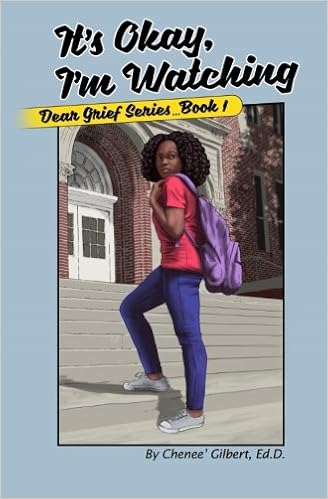
I also had a personal interest in reading this book, as I have a 9 year old daughter myself, and an 8 year old son. And, sadly, one day they are going to encounter grief themselves - as it is part of all our lives. They are also on the threshold of adolescence, so I will definitely be keeping this book close to hand for when they are a little older and as, and when, these subjects arise in their lives - either directly or through the experiences of their friends and peers.
I think this book would be a great classroom resource and should definitely be in the collection of any professional working with young people.
It is a clinical book, not a story book. That said, it is well written and each chapter flows easily into the clever discussion questions that punctuate each chapter.
Written specifically from one cultural viewpoint, that the author presumes you are familiar with, made it a little difficult to get in to but once you reach the questions it becomes much more open, accessible and relatable.
I liked how the author tackled the issues of grief and adolescence simultaneously and there were some beautifully tender moments when the main character is writing her journal to her mother.
Filled with vivid scenes of everyday family life, this book will leave you pondering your own upbringing and reflecting on the traditions and interactions that have shaped your own life.
Poignant, intelligent, factual and honest. Recommended for those with an interest in the subject matter.
I also had a personal interest in reading this book, as I have a 9 year old daughter myself, and an 8 year old son. And, sadly, one day they are going to encounter grief themselves - as it is part of all our lives. They are also on the threshold of adolescence, so I will definitely be keeping this book close to hand for when they are a little older and as, and when, these subjects arise in their lives - either directly or through the experiences of their friends and peers.Wednesday, 22 February 2017
India Study with FREE resource links
So today we had our fab Home Ed Geography Club and the country of the month was India.
DD did her project on a whole variety of things. All self-researched from books. So proud she did it all by herself this month, with no help or prompting! She focused predominantly on the Taj Mahal but also with a variety history, nature and geography as well -


After the children had finished their presentations, we moved to our regular activities. Of course we had our food tasting -

We had homemade daal, cumin fried paneer, not homemade naan bread & not home made Indian sweets (not pictured)! I was amazed that all the daal got eaten (& a little disappointed as I was kinda hoping the have the left overs for dinner ha ha).
We had a table for colouring and games -


DD did her project on a whole variety of things. All self-researched from books. So proud she did it all by herself this month, with no help or prompting! She focused predominantly on the Taj Mahal but also with a variety history, nature and geography as well -

DS and I read a book of Indian Myths together and he talked about his favourite one, The Birth of Indra. And also he talked about the various Indian Gods. He also made the Indian flag and talked about the origins of that.
As always, the work produced by all the children for their Show & Tells was vivid and varied. Almost all the children stood up to present their work, and those that didn't added their contributions to the Sharing Table -


After the children had finished their presentations, we moved to our regular activities. Of course we had our food tasting -
We had a table for colouring and games -

This month I got our colouring pages from -
In addition to this we had our A-Z table - where everyone works collaboratively to try and collate an A-Z of the country of the month. This is a great was to consolidate and reinforce our learning - and all it requires is a few pens and a large sheet of paper (we use rolls of lining paper). This month we couldn't think of an F, Q, U or V!
Instead of a craft this month, me and another parent brought along a few games. We used several but the most popular two were -
And finally we had a table of worksheets, for those that wanted them. This month, I used the fabulous resources I found on -
The greatest success for me, as always, was seeing the children learn together and really engage in the learning activities. They listened beautifully to each others presentations and are always really respectful of each others efforts.
My personal highlight, even beyond their presentations, was that my two, DS especially - who struggles ENORMOUSLY in anything beyond a 1-2-1 environment - were both able to sit down and complete various games and activities - including actually finishing complete colouring pages (this is nothing short of a miracle for these two) -


Sunday, 19 February 2017
Busting 8 Home Education Myths
Currently, in the UK, the law regarding the education of your child states you must make a provision for the full time education of your child. There is a great deal of freedom (hurrah!) in how you choose to do this. Unless your child has an EHCP/ Statement of Educational Needs - in which case you will need to prove you are fulfilling this statement.
But other than that - No, 'they' do not give us a curriculum.
No, 'they' do not monitor & test us - though we can chose to work with the Elective Home Education department if we wish to.
So, given I made a series of Tweets yesterday on #HomeEducation Questions I Have Enjoyed Fielding This Week 😁 I thought I would write a post about Popular Myths & Questions people (sometimes aggressively!) have about Home Education.
Firstly, here in the UK there is a difference in the community between Home Education and Home Schooling. In the UK it is recognized that if you are Home Schooling, then you are formally teaching your children at home - with a curriculum (of your own design) and lessons and so forth. Home Educating families however are educating, as opposed to teaching - so this is more about facilitating your child's learning through a variety of mediums and can include self led learning and elements of more formal learning. Unschooling is child-centered learning - entirely child led, without structure or constraints.
I tend to use a combination of Home Education & Home Schooling, so I will use both terms.
So here are some of the questions I/ we are FREQUENTLY asked -
#1 Is it legal?
Yes, see above legal definition.
#2 But they give you a curriculum to follow right? What about The Curriculum??
Ok, brace yourselves - the curriculum is not A Thing. It's not the law. It has no scientific foundation. It is not a formula for a 'correct' human being.
The curriculum changes frequently - usually as frequently as the Education Secretary (who often has no training or formal experience in Education....) - and often more frequently than that.
The curriculum varies regionally and often from school to school. There is huge scope within the curriculum - it is not a checklist. So the school next to your school may be interpreting the curriculum vastly differently to your child's school. And when your child reaches senior school, what they learn for their GCSEs will depend upon which Exam Board your chosen school is using. What your child can take as GCSE subjects will also vary according to the individual school's timetabling policy.
The curriculum has a hugely political agenda. I want my children to learn, freely. I want them to make their own judgements and nurture their own interests and work ethics. I do not want them to attend Citizenship classes (shudder!) or have Religious Education forced upon them. I also don't want them to sit in endless, mind-numbing assemblies, watching the clock and longing to be doing something more constructive with their time.
Finally, when I served as a Parent Governor at my children's former school, I attended a day long meeting (on a Saturday!) about the 'new' curriculum. Highlights included that foreign languages had been removed from the curriculum (at the time) for Early Years (so ages 4-7). And the entire continent of Asia had been removed from the curriculum (I kid you not!) - Geography was to include Europe & Africa only. Hmmmmmmm! Helpful. These were just a couple of 'highlights' that stood out to me - along with the aforementioned (shudder again) Citizenship Classes.
So, in conclusion, don't set your store in 'The Curriculum' - it's like a wave. Teach your children to ride it, surf it, navigate their way around it but it is a transient thing, not a concrete foundation. Knowledge is power, not 'the curriculum'.
#3 (Usually in response to my answers to #2) So you're a teacher then are you?
Sigh! No, I am not a teacher. I do have 9 GCSEs, 3 A levels & a BA Hons degree in English Literature & Theology if that makes you feel better. But similarly I know fantastic Home Ed parents with no 'school' qualifications at all. Qualifications simply reflect your opportunities, not your intelligence.
As an aside, I originally went to University to do a teaching degree. My whole life I had wanted to be a primary school teacher (insert here 'narrow world view'). Almost as soon as I arrived and begun my teaching practice my heart broke in two - as I realized so very many people are in it for the wrong, wrong reasons. It's not about the child. It's not even about facilitating their learning. It's about stats. It's about League Tables. It's about bums on seats and conformity at all costs. I realized quickly it was not for me. I would be in for a lifetime of fighting battles & injustices and having no life of my own raging against a system that was fundamentally wrong. So I swapped to an academic degree instead.
However, back to the issue of teaching. What makes you think you need to be a qualified teacher to teach your own child? Did a health visitor potty train them for you? Did you need a host of 'professionals' to teach you how to feed, clothe and care for your child thus far? No, you taught them. Sure there are 'experts' - there are forums, books, lectures you can go to. Same in Home Ed - there's an enormous community out there and a wealth of resources. You are not on your own just because you are not in school. We use a lot of the exact same resources your teachers are using in the classroom. We're allowed to you know 😏
We are also in the BEST POSSIBLE POSITION to discipline our children - as we are there 24/7. We get a consistent picture of our children's behavior, their issues, their struggles & challenges. Who can say that when they are away from their child 6-8 hours, often more, a day? Many parents report their child acting completely differently at school versus at home. As Home Educators we see all our children's behavior - and can intervene fairly and frequently, giving them the consistency they need to form healthy attachments, confidence and self esteem.
#4 Do you get them tested?
For what? Diseases??
Do I measure their academic progress? Not any more. I did at the beginning, but then I realized how futile and counterproductive that is.
My goal is not to achieve anything specific. I want happy, healthy, mentally strong kids who will become well rounded, happy, responsible, considerate, motivated adults. I teach them to learn. To like themselves. To pursue their passions and interests. I facilitate their learning by teaching them the tools to study - how to use the dictionary, the thesaurus, reference books, indexes. How to cross reference to ensure the information they find is accurate. We use computers (less than we use books) but they know how to search, word process and programme on Scratch. Some subjects we cover are my choice, some theirs. Their natural direction will, and is, emerging as they have the space and time to explore and spread their wings.
#5 How do you meet both their needs appropriately?
Erm...... you know there's WAY more than 2 kids in a classroom right?????
And you know that because they are of similar age (12 month range) they are by no means at the same level - you probably have an academic ability range of at least 2-3 years in any one 12 month age range classroom.
So, yeah, I'll just leave that there. It's a no-brainer.
#6 But what about socialization?
😄😄😄😄😄😄
Ok, serious hat back on. I'll be honest. DS has struggled more with this. He had 3 really super best friends at school (whom he still considers to be his best friends, and whom we continue to keep up with and see). He has plenty of friends in the HE community but, thus far, he hasn't gelled with any one in particular. Although, recently, it is starting to come as the realization finally sinks in that his friends do not have to be boys, and they do not have to be the same age as him. He really gets on with one particular boy in our Learning Cooperative, who is 5 years old. They are great buds. And the friendship between him and the younger brother of DD's bestie is also flourishing. It just wasn't as instant as these 3 boys at school (although to be honest, that was only after he'd been moved classes as he simply wasn't settling in the class they originally put him in - so school didn't have a magic formula either).
DD, however, has blossomed friendship wise. She has come to really know herself and be comfortable in her own skin rather than seeking the approval of peers. Naturally, this means she forms better, closer, more meaningful friendships. She no longer feels the need to be one of the crowd, to wear what she's wearing, do what she does. She is her own person, and socializes as she feels the desire - rather than being trapped in a cacophony of noise, chaos and confusion and calling it socialization.
And my own personal bug bear - as I've said, I want my kids to learn to be happy, healthy, motivated, emotionally and mentally strong adults. They are not, and never were, going to learn this at the mercy of 29 inadequately supervised 6 year olds. Just aaaaaargh!
My kids both do gymnastics weekly with a huge Home Ed class, and we usually hang around for lunch and games with various friends after.
We run a monthly Geography Club, with about 18 other kids, and a monthly Learning Cooperative with 3 other families (7 kids in total). So they do regular learning alongside other children and the ages range from 5-12 with all the children working at their own level.
In addition to this, we go to Home Ed Sports Club, had a Sport Relief day, are attending a World Book Day party, done Creative Writing workshops, Cake Decorating, Horse Riding - all with groups of other Home Educated children.
My DD recently decided she wanted to audition for a show! Completely off her own back she learnt a written piece, a song & a dance and auditioned. I thought she would have no chance - not having come from a dance school or drama group - but she got in! So she'll be attending weekly rehearsals for that now and make lots of new friends doing so.
She's also doing a PGL adventure holiday this year with a Home Ed group. So she's having all the same social opportunities as her peers. She simply gets to be more selective, which is a truer reflection of real life I think.
Which leads me on to -
#7 What about bullying? How are you teaching them to stand up for themselves in the real world?
Hmmmm, firstly, what a lovely accolade for school that is! What aren't you sending them in to the lions den??
Erm.... because we would rather walk around the lions den thanks! We see it. We're not sheltered from it. We simply choose not to tolerate it.
I absolutely do teach my children about bullying, they know how to appropriately stand up for themselves, how to deal with problems that escalate, peer pressure etc But they have Real Life choices. They do not have to spend 6 1/2 hours a day in a room with their bully. (Would we, as adults? No, we'd go to HR or look for another job - we have CHOICES). Similarly, they don't have to spend 6 1/2 hours a day playing second fiddle to the teachers favourite (and there nearly always is one). They can be who they are and they have confidence in that and in their decisions and choices, therefore they are less concerned with bullying as they are not trying to fit in and be accepted by their peers. Hurrah! How many of us wish we'd learnt that lesson and been that self-assured at their age? I wish I had!
#8 Well, that's all fine for now isn't it, but what about their futures?
Oh my God - really????
Have you seen the stats on school leavers achieving gainful employment or further education?? It's not the gateway you seem to think it is.
Home Educated children can still sit all the same exams your schooled children can. In fact probably more, because they have the flexibility to genuinely choose their options, without limitations.
Is it expensive? Yes, but so is school and uniforms, and equipment, and travel, and residential and day trips, and activities and so on, and so on. You budget and plan accordingly.
And yes, Home Educated children can still go to college or university. And honestly, are often better placed to cope with it, as they are already successful self-motivated learners - something which school leavers aren't necessarily.
They can also seek employment. Most employers will do aptitude tests or similar. It really does become a level playing field again after school. Home Educated children are not disadvantaged in any way. In fact they probably already have a better idea of what they want to do with their lives and are someway towards achieving that goal already - simply because of the flexibility they have with their learning.
For far too long I've used my children's Special Needs as an 'excuse' for Home Educating (it certainly was a big part of the reason for making the jump) but truthfully we would be on this path regardless as I love the children I am raising. I love their individuality. I love that they are wholly confident in who they are. I love that they have freedom, and confidence, and a real zest for life. They are never bored - because they are not relying on a system to spoon feed and institutionalize them. They have so many life skills, and so many friends. This simply would not have happened for us in school.
Sunday, 12 February 2017
Is or has?
I see a lot of posts on social media that spark the inner-debate in me over how you describe/ introduce your child's special needs. Do you say "John HAS autism" or "John IS autistic". (Btw, my son's name is not John).
Of course there is no right or wrong (I don't think), it's personal choice.
But so as not to cause offence to those with autism, tirelessly campaigning for acceptance and challenging ignorance and stereotypes, I wanted to explain why I use IS not HAS.
My children both have autism, they are both autistic. I imagine, as I have not given it an enormous amount of thought previously, that I have on occasion used a mixture of has and is. With DS I think I have always said he IS autistic. Because, for me, he is. Infact I've been saying it alot longer than he's been diagnosed. Because it is a simple matter of fact. He absolutely IS.
He is also a boy. He is also 8 years old. He is also tall for his age. To me, these are things he is. That doesn't mean they define him. He is a boy - so what? He can dress as a princess, wear nail varnish, play cars, trains, build, dig in the mud, obsess about Minecraft, paint, bake cakes, sing - his boyness doesn't define him or limit his choices in any way. But biologically speaking he is a boy. Fact.
Similarly, he IS 8 years old. What does that mean? We have a multitude of charts and scales that tell us what an average (ha!) 8 year old should/ could do. Some are chess champions, some are struggling with CVC words still, some can read Harry Potter (thinking of my DD!) while others cannot ride a bike. Others can swim lengths & lengths, excel at dancing, have a natural affinity with animals. Being 8 years old doesn't define him, but it is biologically something that he IS.
So I guess I kinda feel the same about Autism. It is something he IS. He IS autistic. ( I hate the term Autistic Spectrum Disorder - I freely admit I do find that offensive). But he is autistic. I don't feel he 'has' autism. To me that sounds like a disease, an illness or an apology. None of which I want to give. For me, to say he 'has' autism, implies he 'got' it from somewhere. That he has acquired it, through environmental factors. He hasn't. It is emphatically my opinion that you do not acquire autism. There are a great many things that 'look' like or present similarly to autism (Attachment Disorder for one..., PTSD, Anxiety Disorders to name a few others) that can be acquired environmentally. Over production of cortisol in the brain due to early childhood trauma can result in the brain being re-wired disfunctionally. But none of these things are autism. Autism, quite simply, is always there. It is a neurological state of being. It IS. And I can't reconcile this with the concept of 'has'. To me he didn't 'get' autism any more that he 'got' boyhood or 'got' 8 years old. These are biologically determined things that he IS. Do you see what I mean?
But just because he IS something, does absolutely, catergorically NOT mean he is defined by that thing. Nope. No Way. He is as free as a bird. Freer than many NTs I know. He is what he is and he is free to choose what he wants to be and the direction he wants his life to go.
So, for me, he IS autistic. And so very, very much more 😍💙
Subscribe to:
Posts (Atom)